Do Dogs Train Better With Love or Rewards? The Science Explained
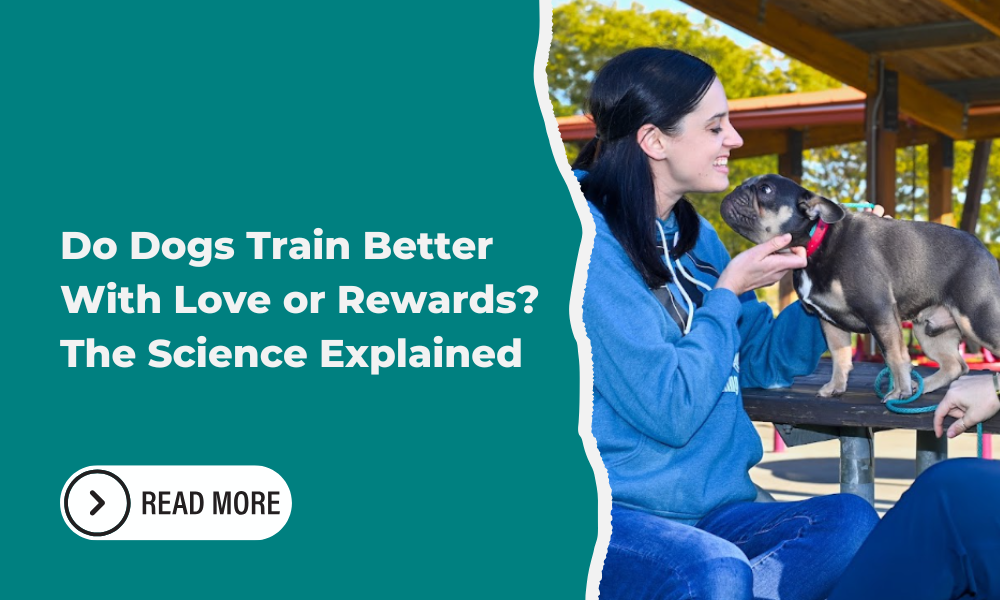
We’ve all seen the classic movie moment: a dog owner looks deep into their furry best friend's eyes, says, "Good boy," and the dog instantly transforms into a perfectly behaved angel. It’s a beautiful sentiment, and it feeds into a common belief among pet parents—the idea that "My dog should just obey me out of pure love and respect."
It’s a romantic notion, but scientifically speaking? It’s a myth.
While your dog undoubtedly bonds with you, expecting them to master a complex behavior like a flawless recall or loose-leash walking purely out of affection is a recipe for frustration.
Let’s dive into the fascinating science of how dogs actually learn, and why the "love vs. rewards" debate isn't quite what it seems.
1. Operant Conditioning: The Science of "What's in It for Me?"
At the heart of all modern dog training is a behavioral science concept called operant conditioning. Coined by psychologist B.F. Skinner, it sounds complex, but it boils down to a very simple rule: Animals repeat behaviors that have pleasant consequences.
Dogs are pragmatists. They don't navigate the world with a human moral code of "right" and "wrong." Instead, they operate on a feedback loop of actions and outcomes. If a dog sits, and a piece of chicken appears, their brain notes: “Sitting equals chicken. I should do that again.” When we train a dog, we are actively using positive reinforcement to shape these feedback loops.
2. Why Rewards Accelerate Learning
Why do we use treats instead of just a pat on the head when teaching something new? It comes down to brain chemistry and processing speed.
- The Dopamine Hit: High-value rewards (like freeze-dried liver or a favorite tug toy) trigger a rush of dopamine in a dog’s brain. Dopamine isn't just a feel-good chemical; it is a crucial driver of attention and memory formation.
- High Value = Fast Tracking: In a distracting world, a piece of kibble or a scratch on the chin has to compete with squirrels, cars, and strange smells. High-value rewards cut through the noise, telling the dog’s brain exactly which behavior was the winning one.
Simply put, rewards make learning efficient and fun. It turns training into a game your dog actually wants to win.
3. The Exit Strategy: How to Fade Treats Properly
A common worry for owners is, "Am I going to have to carry hot dogs in my pockets for the next fifteen years?" The answer is no. Once your dog reliably understands a command, you transition from a continuous reinforcement schedule (a treat every single time) to a variable reinforcement schedule (treating randomly).
Think of it like a slot machine. If a slot machine paid out $5 every single time you pulled the lever, you'd get bored quickly when it stopped. But if it pays out unpredictably, you keep pulling that lever. By fading treats and offering them intermittently, the behavior becomes highly resistant to stopping. Eventually, the treat pouch stays home, and the good behavior remains.
4. When Affection IS Reinforcement
Does this mean love and affection have no place in training? Absolutely not! The trick is understanding when affection qualifies as a reward.
Affection is a learned reinforcer. For a young puppy or a newly adopted dog, a pat on the head might actually be distracting or neutral. But as your bond grows, your praise, smiles, and chest scratches take on real value.
- Maintenance Mode: Once a behavior is learned, a enthusiastic "Yes! Good girl!" can easily replace a treat.
- The Power of Play: Life rewards—like getting to go outside, chasing a ball, or getting belly rubs—are incredibly potent forms of affection that reinforce good manners every day.
Training your dog isn't a choice between being a cold, robotic treat-dispenser or a sentimental pushover. True science-based training uses high-value rewards to build the behavior, and uses deep, authentic affection to maintain it and strengthen your lifelong bond.
Ready to unlock your dog's full potential? Training should be a joy, not a battle of wills. Our certified trainers know exactly when to leverage high-value rewards and when to use real-life affection to get fast, lasting results. Contact us today to book your FREE Transformation Session.


Share On: