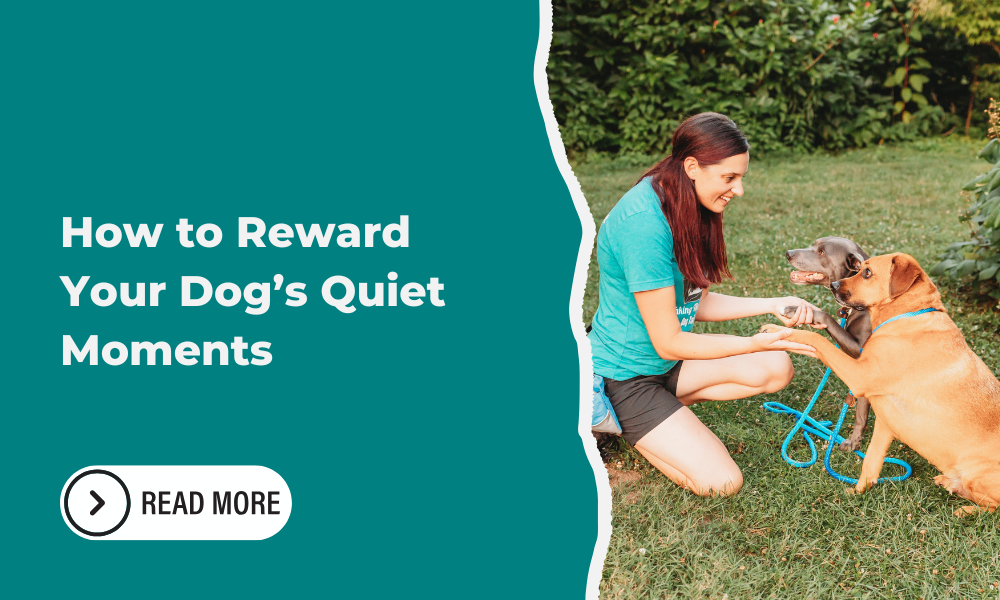
How to Reward Your Dog’s Quiet Moments
Training Calm: Why Most Owners Reward the Wrong Moments
Picture this: You’re relaxing on the couch, and your dog is quietly chewing a toy on their bed. You ignore them because, well, they're finally being good. But the second they start barking at you, digging at the carpet, or stealing your shoe, you leap into action.
Suddenly, your dog gets your full, undivided attention. Even if you're scolding them, in your dog’s mind, they just won the lottery. This is the attention trap, and it's the number one reason well-meaning owners accidentally train their dogs to misbehave.
What Gets Rewarded Gets Repeated
Dogs are master opportunists. They do what works to get what they want. If the only way to get you to look at them, talk to them, or move toward them is to push your buttons, they will happily press those buttons all day long.
If you only acknowledge your dog when they are hyper, anxious, or demanding, you are accidentally putting those exact behaviors on a pedestal. To get a relaxed dog, you have to flip the script and start rewarding the quiet moments.
Look For the Quiet: Calm Behaviors Worth Marking
We are so conditioned to look for bad behavior that we completely miss the good stuff. Start actively looking for—and rewarding—these peaceful moments:
- Four on the floor: Standing quietly instead of jumping up when you walk by.
- The "heavy sigh": Lying down and letting out a deep, relaxed breath.
- The hip shift: Lying down with their weight shifted to one side (a sign they aren't about to spring up).
- Passive watching: Looking at a distraction (like a cat or a delivery truck) and choosing to look away without reacting.
How to Integrate Calm-Marking into Daily Life
You don’t need to set aside an hour a day for "calm training." Instead, bake it into your normal routine.
Keep a few small jars of kibble or low-calorie treats up on high shelves around your house. As you go about your day, keep an eye out for those calm behaviors. When you spot one, gently drop a treat right between your dog's paws. No excited praise, no high-pitched "Good boy!"—just a quiet, seamless delivery of a reward.
'Capturing' vs. Luring: Let Your Dog Do the Work
When most people think of training, they think of luring—using a treat like a magnet in front of the dog's nose to guide them into a sit or a down.
Training calm requires a different tool: capturing. Instead of telling your dog what to do, you simply wait for them to organically choose a calm behavior on their own, and then you "capture" it with a reward. Capturing is incredibly powerful because it teaches your dog to think, "Hey, when I just chill out on my own, good things happen."
Let Us Do the Heavy Lifting
Building a default setting of calm takes consistency and hundreds of repetitions throughout the day. If you're struggling to find the time, our Day Train program can help. We actively shape and reward calm behaviors throughout every single session, giving your dog the foundation they need to be the peaceful companion you’ve always wanted. Reach out today to get started!
Share On: