How to Build a Rock-Solid Recall — Even Around Distractions
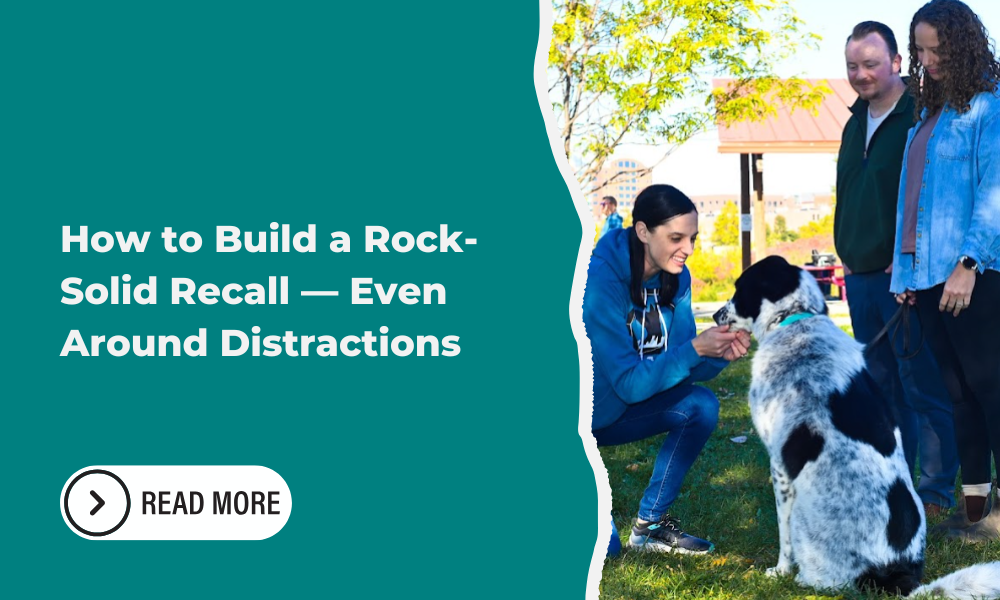
We’ve all been there: you call your dog at the park, and they look at you, look at a squirrel, and choose the squirrel. Recall failure is one of the most common frustration points for dog owners, usually because we ask for off-leash freedom before building a foundation strong enough to compete with the real world.
Here is how to fix it and build a recall that works when it counts.
The "Poisoned Cue" Problem
If your dog ignores "Come," you may have accidentally poisoned the cue.
A cue becomes poisoned when it predicts something negative (like leaving the park or getting a bath) or when it is repeated endlessly while the dog ignores it. If you repeat "Come, come, COME!" while your dog sniffs a bush, you teach them that your cue is optional background noise.
Step 1: Building High Value for the Cue
Before testing your dog around distraction, make coming to you the most rewarding game in their life.
- Pick a fresh cue: If "Come" is ruined, start clean with "Here" or a whistle.
- Pay generously: Use high-value rewards like boiled chicken, hot dogs, or a favorite tug toy.
- Say it once: Call the cue inside a quiet room. The moment your dog turns toward you, mark with "Yes!" and reward heavily when they get to you.
- Never end the fun: Most of the time, reward your dog and let them go right back to playing.
Step 2: The Long Line Protocol
Never call your dog in an open area without a way to prevent them from ignoring you. Use a long line (a 15- to 30-foot leash).
The long line gives your dog freedom while keeping you in control. If you call your dog and they hesitate, gently reel them in to guide them toward you. You eliminate the option of running off.
Step 3: Adding Distractions Systematically
Don't jump straight from your living room to a crowded dog park. Increase difficulty in stages:
- Low Distraction: Living room or hallway with zero traffic.
- Medium Distraction: Fenced backyard or quiet park with sniffable grass and distant sounds.
- High Distraction: Public park on a long line with other dogs or bikes passing by.
- Master Distraction: Off-leash safe areas around wildlife or active play.
Step 4: Proofing in Real Environments
"Proofing" means practicing across different locations and contexts until the response becomes automatic.
Practice random recalls on every walk while your dog is on the long line. Call them mid-sniff, reward generously, and send them back to sniffing. This teaches your dog that paying attention to you doesn't end their fun—it unlocks more of it.
By keeping your cue clean, using a long line, and working through distractions gradually, you can turn an unreliable recall into a bulletproof habit.

Share On: